| Missouri State > CHPA > Matthews Home Page |
|
|
Religious Studies 101 (Honors) Literature and World of the Old Testament
Dr. Victor H. Matthews
1.Texts Required:
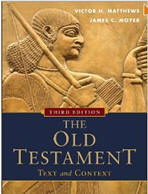
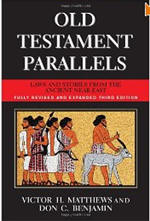
a. V. Matthews & J. Moyer, The Old Testament: Text and Context (3rd edition; Baker Academic, 2012) b. V. Matthews & D. Benjamin, Old Testament Parallels (3rd edition; Paulist, 2006) d. Any one of the modern
translations of the Bible--preferably the New Revised Standard Version, New
Jewish Publication Society Version, or New International Version. Do not use
the King James Version. Although it is a beautiful literary translation, it
is hard to understand for most modern students and is outdated. I will use
the NRSV in class. An on-line version of the
NRSV translation is available
at:
http://www.devotions.net/bible/00bible.htm.
On-line concordances featuring several other biblical translations can be found at: http://bible.gospelcom.net and www.biblestudytools.com. An on-line version of the NRSV translation is available at: http://www.godweb.org/nrsv.html
A Glossary of Religious Studies Terms: http://www.deinde.org/resources/glossary/glossary.php I encourage students to click on the various web links that I have established throughout this syllabus to obtain additional information. A directory to on-line resources for biblical studies can be found in my website at: http://courses.missouristate.edu/VictorMatthews/favorite.htm The Old Testament: Text and Context will be used as a supplement to lectures. Students will benefit by using this volume to increase their understanding of both the biblical material and the lectures. Old Testament Parallels contains translations of ancient Near Eastern texts that will be used in class discussion comparing them with biblical stories and laws.2. Course
Description: This
course is a part of the
General
Education curriculum in the area of Culture and Society/Humanities. The
goals of the General Education program are found at:
http://www.missouristate.edu/GeneralEducation/Goals_GenEd.htm.
This General Education
course contributes to the development of your intellectual abilities and
dispositions, including striving to be well informed and open-minded,
looking for multiple possibilities, being able to deal with ambiguity, and
intellectual self-awareness. - This course encourages striving to be well informed by
requiring knowledge of primary sources (the Hebrew
Bible/Old Testament and related documents) and modern methods of interpretation.
It encourages open-mindedness through exposure to a variety of attitudes
toward this literature both in its historical setting and the present.
- This course encourages looking for multiple possibilities and being able to
deal with ambiguity through exposure to a variety of ways that ambiguous and
conflicting texts and other data are interpreted by historians and other
readers. This procedure promotes
sensitivity to multicultural concerns.
- This course encourages intellectual self-awareness, i.e., being conscious of
one’s own thinking process, by an emphasis on critical thinking.
Given the influence and importance of both the Hebrew Bible/Old Testament
on Judeo-Christian Culture and, thus, American society, REL 101 provides an
outstanding setting in which students can reflect on the cultural and social
contexts of their thinking and the range of biases these diverse contexts
create. As a way of further illuminating these materials, attention will also be given to the history and religion of Israel as well as the other peoples of the ancient Near East. Its application to the Public Affairs Mission of the University can be found in its efforts to educate students about the past so that they can build upon this heritage in making informed decisions about their own culture and the future direction of society. Student input is welcomed as a partial guide to material covered. 3.
Classroom routine: Since this is a course
introducing the biblical materials, the presentation in class will be for
beginners. The biblical text will be carefully followed to determine and
explain what the authors are saying. This will involve a lecture/ discussion
format and audio-visual materials. I will be
constantly asking questions of students to emphasize points and
determine mastery of the material. 4. Religious Studies Courses in a State University: The U.S. Supreme Court (Abington v. Schempp) in 1963 encouraged the objective study of religion and the Bible. This is why we teach an introductory course to the Old Testament/Hebrew Bible at Missouri State. However, the approach here is different from that taken in a religious group. We will concentrate on reconstructing what the text originally meant to its ancient audience in the light of its ancient Near Eastern setting rather than on what the text means for us today. You do not have to have a faith commitment in this course, nor will you be asked to abandon your faith. My purpose is to increase your knowledge and understanding of the Old Testament/ Hebrew Bible, and to help you think carefully and in new ways about what it originally meant. You will earn a good grade in this class the same way you do in other courses, not by being more religious. 5. Purposes: a. Provide students with a basic understanding of the OT/HB and of the social worlds of ancient Israel that will serve as the foundation for future study. b. Provide the student with a basic knowledge of the history of the biblical periods, noting the relationship between Israel and the other nations of the ancient Near East. c. Provide students with a basic knowledge of the physical environment and geographical features of the ancient Near East. d. Give students an understanding of the principal beliefs found in the OT/HB about God and humankind. e. Present to students for their use the tools and approaches that scholars use to study the OT/HB. f. Prepare students to deal openly and intelligently with the text of the OT/HB, neither minimizing nor over-emphasizing the very real historical and intellectual difficulties that they will encounter. g. Demonstrate to students that the study of religions in a state university setting is a natural part of a humanities curriculum and of the university's Public Affairs mission. h. Help students to take seriously, state accurately, and evaluate thoughtfully positions other than their own. 6. Attendance: Statistical analysis has shown that regular attendance is the key to good grades. It is expected that all students will be present except for emergencies. 7. Class Participation: A significant portion of your grade (100 points) is dependent upon class participation. I will assign this grade at the end of the course. It will be based on attendance, ability to answer questions during regular and scheduled class discussions, in-class assignments, willingness to ask questions and seek help (both in and out of class), responses to posted Study Question on the Blackboard forum (= 40 points of 100 point total), and general improvement in class discussion over the course of the semester.
8. Inclusive Language: In line with current style guides, I will be using inclusive language. This means that I will use language that includes women whenever possible. Instead of "man" I will use "human beings." Instead of "he" I will use "he or she," etc. I urge you to follow my lead both orally and in written form. 9. Exams: There will be three exams and a final. They will consist of essays, short identifications, and map questions. These exams will be given approximately at the 4th, 8th, & 12th week of the course. The final will cover both newly discussed material and a comprehensive essay. Before each exam I will provide students with a study guide. Please bring a blue book and a pen on each exam day. 10. Make-Up Exams: Make-up exams (though usually more difficult than regular tests) will be permitted only for those students with LEGITIMATE explained absences. Students should strive to notify me in advance if they know they will have to be gone on a scheduled exam day. 11. Written Assignment: Each student is required to do the following: You are to read two articles dealing with either archaeology or aspects of the history or culture of the world of the Old Testament/Hebrew Bible from journals that may be obtained in the Meyer Library or on-line. You are then to write a short (2 pages) summary of each article's
contents and a one page personal analysis of: I recommend the following popularly written journals: Biblical Archaeologist (renamed Near
Eastern Archaeology) -- BS620. A1 B5 Choose specific items
in each article upon which to base your analysis. Be
sure to include: The first of these analyses (worth 25 points each) is due September 21, 2012. The second is due on November 16, 2012. A two point per class day penalty will be imposed on each paper submitted after the date it is due.
Each of you will become the “expert” on
the topics covered in your article reviews and
you will be called 12. Cheating: Missouri State University is a community of scholars committed to developing educated persons who accept the responsibility to practice personal and academic integrity. You are responsible for knowing and following the university’s Student Academic Integrity Policies and Procedures, available at www.missouristate.edu/policy/academicintegritystudents.htm. You are also responsible for understanding and following any additional academic integrity policies specific to this class (as outlined by the instructor). Any student participating in any form of academic dishonesty will be subject to sanctions as described in this policy. If you are accused of violating this policy and are in the appeals process, you should continue participating in the class. I would also direct you to the university statement of community principles. 13.
Assessment: Students'
command of the materials presented in this course will be assessed through
written exams, written assignments, journal article critiques, class discussion,
in-class oral presentations, and the ability to answer the instructor's
questions during class. These methods of assessment will help gauge the
effectiveness of the presentation by the instructor as well as help demonstrate
the usefulness of In addition, each student will be asked to write a reflective essay demonstrating how you have grown in these abilities and dispositions by taking this class and you will be asked to answer questions on a course assessment survey at the end of the course. 14. Grading: I will be using plus/minus grades. The final grade will be computed as follows: Exams I, II, & III- 225
points (75 points each)
Plus/minus
grades:
In order to give students appropriate credit for their work, grades will be
reported with plusses and minuses at the end of the semester. Your overall
numerical score in the class will be converted to a letter grade on the
basis of the following chart: Borderline grades will be determined by such factors as attendance, the final exam, completion of work on time, evidence of hard work and a willingness to seek help, and general contribution to class discussions.If you
stop attending this class but do not follow proper procedure for dropping
the
class, you will receive 15.
Disability Accommodation:
To request academic
accommodations for a disability, contact the Director of the
Disability Resource Center,
Plaster Student Union, Suite 405, (417) 836-4192 or (417) 836-6792 (TTY),
www.missouristate.edu/disability.
Students are required to provide documentation of disability to the
Disability Resource Center prior to receiving accommodations. The Disability
Resource Center refers some types of accommodation requests to the
Learning Diagnostic Clinic,
which also provides diagnostic testing for learning and psychological
disabilities. For information about testing, contact the Director of the
Learning Diagnostic Clinic,
(417) 836-4787,
http://psychology.missouristate.edu/ldc. 16. Discrimination Policy: Missouri State University is an equal opportunity/affirmative action institution, and maintains a grievance procedure available to any person who believes he or she has been discriminated against. At all times, it is your right to address inquiries or concerns about possible discrimination to the Office for Institutional Equity and Compliance, Park Central Office Building, 117 Park Central Square, Suite 111, (417) 836-4252. Other types of concerns (i.e., concerns of an academic nature) should be discussed directly with your instructor and can also be brought to the attention of your instructor’s Department Head. The Missouri State statement of non-discrimination can be found at http://www.missouristate.edu/eoaa.htm. 17. Office Hours: Students should feel free to consult with me about the course and their work. My office is STRO 215 (inside the Dean's Suite in STRO 207) and I will be there MTWF 9:00-10:00 and 2:00-3:00 on Thursday. If you can not meet with me during these times, see me after class and I will arrange a mutually convenient time for us to get together. The Dean's office phone is 836-5529 and the secretary can make an appointment for me. I can also be contacted by e-mail at: VictorMatthews@missouristate.edu 18. Cell Phone Use:
As a member of the learning
community, each student has a responsibility to other students who are
members of the community. When cell phones or pagers ring and students
respond in class or leave class to respond, it disrupts the class.
Therefore, the
Office of the Provost
prohibits the use by students of cell phones, pagers, PDAs, or similar
communication devices during scheduled classes. All such devices must
be turned off or put in a silent (vibrate) mode and ordinarily should not be
taken out during class. Given the fact that these same communication
devices are an integral part of the University’s emergency notification
system, an exception to this policy would occur when numerous devices
activate simultaneously. When this occurs, students may consult their
devices to determine if a university emergency exists. If that is not
the case, the devices should be immediately returned to silent mode and put
away. Other exceptions to this policy may be granted at the discretion
of the instructor. TENTATIVE SCHEDULE -- RELIGION 101 Textbooks will be referred to below in abbreviated form (OTC and OTP). Reading should be completed as assigned before class. You are responsible for all reading assignments and you will be questioned about the material they contain in class discussion or asked to do free writing assignments about them. I will provide you with study questions after each class period that will form part of our discussion during the next class. Plan to spend at least four to six hours per week in preparation for this class. All reading
assignments, Power Point presentations, and Study Questions will be posted
for each segment of the course on the Blackboard site.
You click on CONTENT for the assignments and
other study aids.
You click on FORUM to post your responses to
Study Questions.
Section One: Introduction to the class. Syllabus, assignments, and grading. Discussion of tools for biblical study. OTC, 1-5.
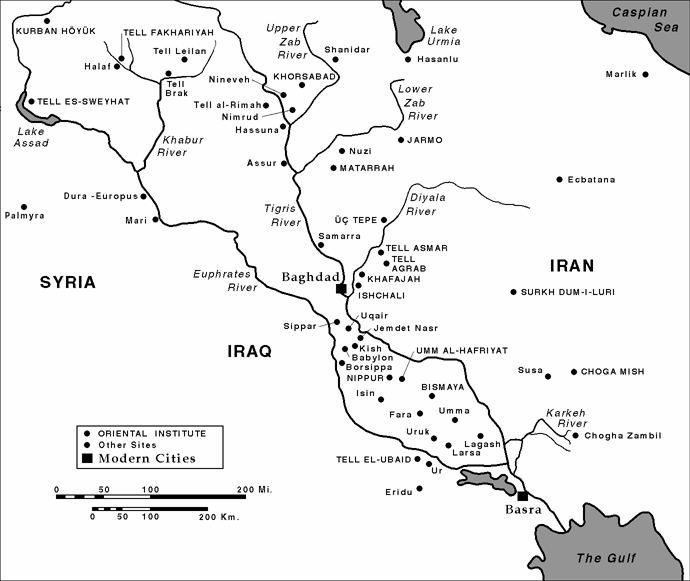
Physical Environment of the Ancient Near East. Discussion of the
major geographical features of the
ancient Near East & their influence on cultural development.
Read OTC, 5-14.
Bible Maps can be found at:
http://www.keyway.ca/htm2002/keyway07.htm and at
Archaeology. Discussion of the
methods, values and
limitations of archaeology for biblical research and field .
Oral Tradition and Canon.
Writing Systems,
textual analysis,
Dead Sea Scrolls,
development of the canon,
Creation Stories and the differences between Polytheism and Monotheism.
Read OTC,
35-39; The
Flood Story. Read Gen 6-9; OTC, 39-41; OTP,
"Stories of Gilgamesh," 21-32 and
"Stories of Atrahasis," The
Ancestors: Abraham, Isaac, and Jacob. Read Gen 12, 16-19, 21-34 and
OTC, 41-48; OTP, "Nuzi
Joseph, Goshen, and Slavery. Read Gen 37-45; OTC, 48-49; OTP, "Stories of Anubis & Bata," 65-69.
Moses and the Exodus Event. Read Exodus 1-5, 10-14, 19-20, 24, 32-34;
OTC, 50-53; OTP,
"Annals of EXAM #1: Genesis and Exodus (75 points) Section Two: Sinai, Wilderness, Law. Read Ex 21-22; Num 13, 16, 20, 22-24; Deut 21-22, 34; OTC, 53-58; OTP, "Code of Hammurabi," 105-114, and "Stories of Balaam," 131-133.
Joshua and the Conquest. Read Joshua 1-11, 24; OTC,
58-71; OTP, "The El Amarna
Letters," 146-150
Discussion session:
Canaanite
Culture and the Role of the Judges.
Read Judges 1-6, 9, 11-21; OTP,
Early Monarchic Period: Samuel & Saul. Read OTC,
83-88; OTP,
"Annals of Tiglath-Pileser I," 165-166,
Early Career of David. Read 1 Sam 16-19, 21-22, 24-28, & 31 and OTC, 88-92. The
United Monarchy of David. Read 2 Sam 1-7, 11-17, 20, 24; OTC,
92-98; OTP,
"Karatepe Annals
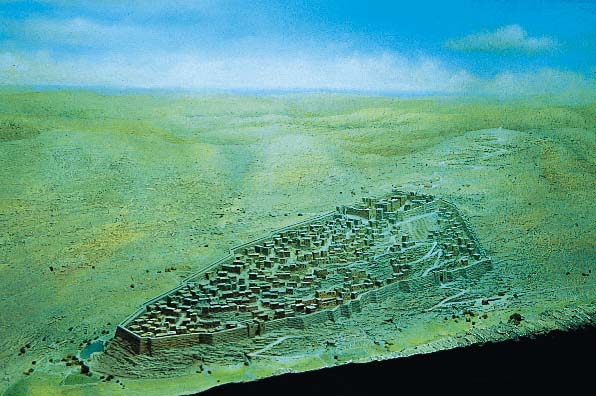
Model of the City of Solomon's Rule. Read 1 Kgs 1-5, 8, 11. Read OTC, 99-102. View the video at http://www.pbs.org/wgbh/nova/bible/program.html EXAM #2: Conquest to Solomon's Kingdom. (75 points)
Section Three:
(see
http://www.kchanson.com/CHRON/isrkings.html for a basic chronology of
the Division of the Kingdom. Read OTC, 102-105; 1 Kgs 12-14, 16.
Characteristics of prophets. Read OTC, 105-115;
OTP, "Mari Letters," 341-346. In class discussion of the role
Elijah, Elisha, and Conflict between Kings and Prophets. Read
OTC, 114-123; 1 Kings
17-19, 21-22; Overview of the History of the Late Monarchy. Read OTC, 125-131.
Amos and Israelite Society. Read OTC, 131-135;
OTP, "Yavne-Yam Letter," 355-356; and
Hosea and the Fall of Israel. Read OTC, 135-141; Hosea 1-4, 6,
11; 2 Kgs 17; OTP, "Annals
Isaiah of Jerusalem. Read 2 Kgs 15-18; Isa 5-11, 20, 36-37; Micah 1, 3,
6; OTC, 141-155;
Deuteronomic Reform. Read 2 Kgs 22-23; Deut 12-14; OTC, 156. Jeremiah and the Last Days of Judah. Read OTC, 165-179; OTP, "Lachish Letters," 201-203; "Annals of Nebuchadnezzar," 195-197; 2 Kgs 24; Jeremiah 1, 5, 7, 13, 16, 18-19, 21, 26, 28-29, 32, 36. EXAM #3: Late Monarchy Period (75 points) Section Four:
Ezekiel and Babylonian Exile. Read OTC, 181-191; OTP,
"Laments for Ur,"
247-255; Psalm
137;
Second Isaiah and the Promise of Return. Read OTC, 194-200;
OTP, "Decree of Cyrus,"
207-209;
Jewish Identity Movement and the Return from Exile. Read Haggai 1-2;
Zech 1-4; Isaiah
58-60; Post-Exilic Yehud. Read OTC, 223-228. In
preparation for our discussion of the Restoration and Reconstruction Period,
read and the 1.
Ezra 1, 2:1-70 6. Neh 1:1-7:5 The
Psalter. Read Psalm 1, 8, 18, 22, 23, 51, 91, 95, 104, 115, 122, 145,
148; OTC, 250-2545; OTP,
"Hymn to
Wisdom Literature. Read Eccl 1-5; Prov 22-24, 31; OTC, 237-243;
OTP, "Teachings of Ptah-Hotep," 283-288
Class Discussion: Job. Read Job 1-12, 31, 38-42;
OTC, 243-250; OTP, "A Sufferer and a
Friend in Babylon,"
Judaism and the World. Read the entire books of Ruth, Jonah, and Esther;
OTC, 215-219; 228-236; Daniel and the Hellenistic Period: Read OTC, 257-271; Dan 1-7, 12; OTP, "Visions of Neferti," 335-340.
FINAL EXAM:
Covering the last section of the course and a Comprehensive essay question.
Final Exam: December in STRO 350
This schedule is not carved in granite. There
will undoubtedly be some
departures from it -- especially if the class
chooses to spend more time on a particular subject. Please come
Return to Victor Matthews Home Page This site was last updated on
March 30, 2012.
|
||||||
 HOME
HOME
Copyright © 2000 Board of Governors,
Missouri State University
URL: http://www.missouristate.edu/chpa
Maintained by Victor Matthews
Last Modified:
June 22, 2012