EARTHQUAKES AND THE EARTH'S INTERIOR

Seismology is the
study of earthquakes--the photo to the left shows the result of an earthquake--there
is a large seismic area in Missouri related to the New Madrid Fault system and
a large earthquake is predicted in that region within the next 50-100 years
I. Definition,
causes, and morphology of earthquakes
A. Definition of earthquake
- vibration of the Earth's
surface by sound (shock) waves usually generated by the energy released
from rocks rupturing under stress or by friction between moving rock
materials at or mostly below Earth's surface
- click here for more on definition of earthquake
B. Some major causes of earthquakes
1. Landslides, rockslides, slumping
or "caving in" of the Earth's surface, meteor
impacts and nuclear explosions
2. Friction (grinding, bumping) between
moving rock materials associated with volcanism
3. Fracturing or movement of rock
materials along faults or plate boundaries caused by Elastic Rebound are the
most disastrous earthquakes form--this can dislodge enormous volumes of rock
and unconsolidated materials causing mass wasting to occur such as rockslides
and slumping of surface material---liquefaction causes
rigid soils to act as a liquid during an earthquake—see
pages 348-349 in text
C. Morphology of earthquakes and related terms
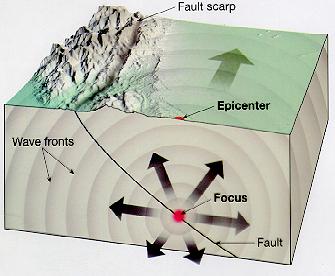
1. Focus or
hypocenter
·
is the exact place of origin of the earthquake disturbance
and with few exceptions is located below the surface of the Earth
2. Epicenter
·
is the position on the surface of the Earth directly above
the focus
click here
to see the focus and epicenter -- or see
page 337 in text for more examples of focus and epicenter
3. Foreshock(s)
·
is (are) the earthquake(s) generated at or very near the focus
of the main earthquake disturbance and prior to the main shock--the
foreshock(s) is (are) smaller in magnitude than the main shock but may be of
substantial magnitude and precede the main earthquake by a short or substantial
time interval
4. Aftershock(s)
·
is (are) the earthquake(s) generated at or very near the
focus of the main earthquake disturbance and following the main shock---the
aftershock(s) is (are) smaller in magnitude than the main shock but may be of
substantial magnitude and follow the main earthquake by a short or substantial
time interval
5. Main shock
·
is the main earthquake disturbance generated at the focus
II. Earthquake waves
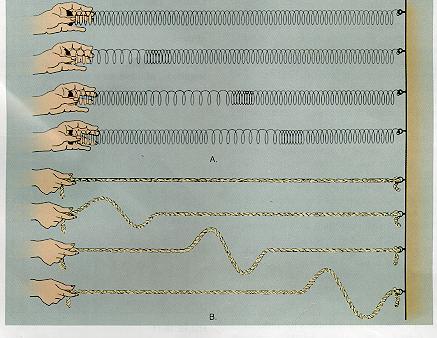
1. Body waves
·
waves which travel below the Earth's surface
·
P (primary) wave--moves essentially in a straight line path
·
S (secondary) wave--moves in a looping motion along its path
of movement
click here
to see the manner of travel of P and S waves (P wave=spring S wave=rope)
or see page 341 in text
2. Surface (L, Love, Long)
wave---moves along the surface of the Earth
B. Arrival of earthquake waves at seismic stations
- seismic waves move away
in all directions (360 degrees-through 3 dimensions) from the focus---the
P and S waves which move upwards will reach recording or seismic stations
and the earthquake recording devices---the L waves are also recorded
1.
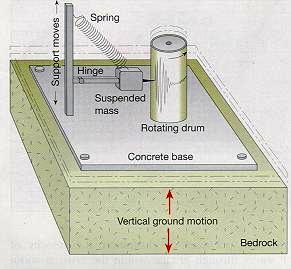
Seismograph--an instrument which detects and records seismic waves---as seismic
waves shake the foundation on which this instrument is attached, a pen records
the waves on a paper attached to a rotating drum
·
click here to see the basic
parts of a seismograph or page 340 in text
2.
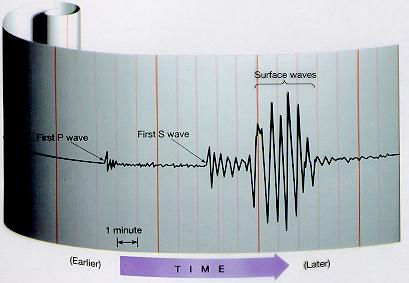
Seismogram--the paper on the seismograph with the earthquake wave recordings
·
click here to see the seismogram
and the recorded seismic waves or see
page 342 in text
see
more on seismographs and seismograms
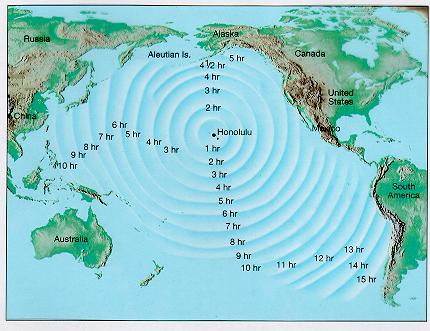
C. Tsunami (seismic sea wave)
- is a sea wave formed
when an epicenter is located near or in the ocean basin
- click
here to see the generation of a tsunami or see page 350-351 in text
- click here to see more on a tsunami
A. Travel time (time distance) graph
·
using the
differences in arrival times of the P and S waves at a seismic station
(obtained from information on a seismogram) and a graph which plots the
distance body waves travel to the seismic station as a function of time, the
distance of
an earthquake epicenter from a seismic station can be determined
·
click
here to see the time travel graph or page
342 in text--as can be seen on the travel time graph, the distance away
from the epicenter to the specific seismic station in this example is 3800
kilometers--but the direction from the station is still not known-- click on the first diagram in upper left and see the
ground distance to the epicenter using the arrival of P and S waves on the
seismogram.
·
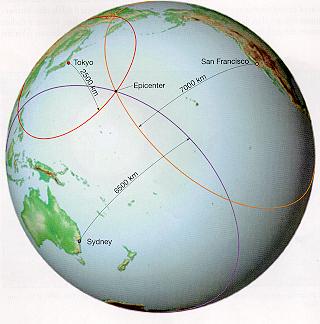
B. Three point or three arc method
- usually the distance
from three seismic stations are used to locate the epicenter by
triangulation---an arc representing the distance from a seismic station
through 360 degrees is constructed on a map---this is done for three
seismic stations---the intersection of the three arcs is the location of
the earthquake epicenter---the closer the three stations are to the
epicenter the more exact the location—the link below, shows seismic
stations in Sydney, Australia, San Francisco and Tokyo used to triangulate
the location of an epicenter in the Pacific Ocean
- click
here to see and use of the 3 arc method--- also see page 343 for 3 other cities
IV. Seismic intensity and magnitude
A. Definitions
1. earthquake intensity is a measure
of the effects or physical destruction caused by an earthquake disturbance at a
particular surface
location
2. earthquake magnitude is a measure
of the strength of or energy released by an earthquake
disturbance
B. Factors influencing the destructive results (intensity)
of an earthquake at a particular surface location
- 1. total energy released
at focus (magnitude)
- 2. distance of focus to
surface location
- 3. type of rock support
in an area--more damage, higher intensity, will occur at surface if
support material is a thick soil (greater settling effects) and less
damage if solid bedrock
- 4. building construction
- 5. density population
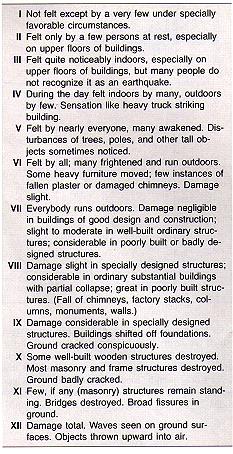
C. Mercalli intensity scale
(modified)
- is a listing of
increasing physical destructive results numbered from I to XII
- click
here to see the Mercalli Scale or see page 344 in text
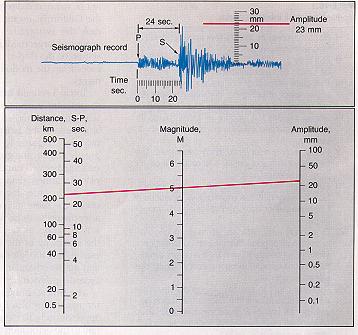
1. Richter Scale
·
describes the strength of the earthquake and is obtained by
relating the difference in time arrivals of the P and S waves and wave height
or amplitude at a given seismic station
·
click here to see the
determination of the Richter Number or see
page 345 in text
·
after plotting the lag time value of S-P waves and the
amplitude value on the respective column plots, a line connecting these two
points intersects the center plot at the Richter value--the lag time value
would increase and the amplitude value decrease with a function of distance of
the station from the epicenter resulting in essentially the same Richter number
for all seismic stations--- slight differences in the Richter number for an
earthquake may result from one seismic station to another because of extreme
distances from the epicenter
2. Magnitudes of energy
·
the energy released by the first atomic bombs were
equivalent to the energy released by an earthquake with a Richter value of 5
·
each increase (or decrease) in Richter number by one equates
to a multiple of 32 times more (or less) energy released--a magnitude of 7 is
equivalent to 32x32(1024) x the energy released by an earthquake with a 5
magnitude
·
usually a magnitude of 4 or less is a minor earthquake while
some of the most damaging quakes measure 8.5-9
V. Earthquake categories
- based on depth to focus
A. Shallow type
- if focus is 0 to 42
miles deep--comprises about 85% of total global energy released by
earthquakes
B. Intermediate type
- if focus is 42 to 210 miles
deep--comprises about 12% of total global energy released by earthquakes
C. Deep type
- if focus is 210 miles or
greater--comprises about 3% of total global energy released by
earthquakes--deepest known focus is 420 miles
VI. Geographical distribution of
earthquake epicenters—see page 347 in text
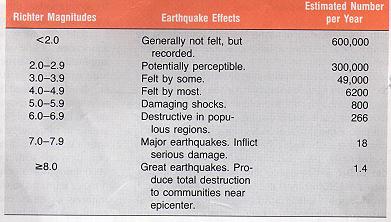
- there are nearly 1 million global earthquakes per year
with major tremors occurring much less frequent than minor tremors
- click
here to see the detailed breakdown on magnitudes of earthquakes
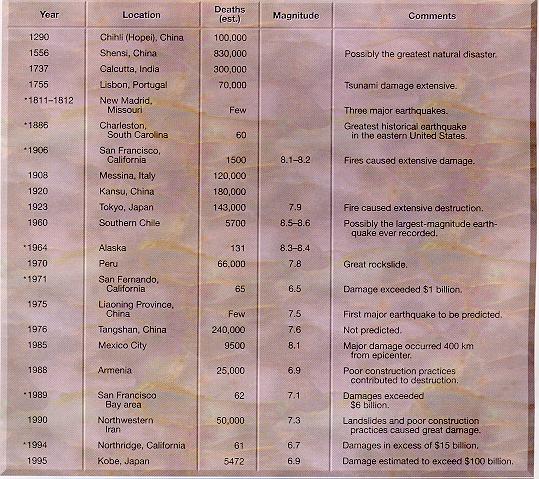
- click
here to see a listing of historical earthquakes or page 354 in text
A. Circum-Pacific region
- is an area of many plate
boundaries especially of the convergent type where about 80% of global
earthquake energy is generated each year--within this region the
California-Nevada area averages about 5000 earth tremors per year and
accounts for about 90% of the total earthquake energy generated in the US
B. Mediterranean region
- a large convergent plate
boundary and smaller ones are present across this region and explains the
generation of about 15% of global seismic energy each year
C. Ocean ridge areas and intra-continental areas
- these
two areas constitute other areas of major earthquake activity---the
intra-continental areas are not associated with known plate boundaries
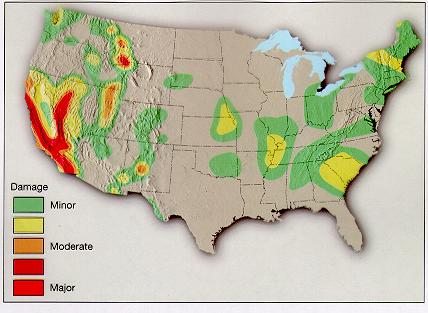
- click
here to see the intracontinental earthquake locations and risk areas in
the US
- probably the most cited
example of an intra-continental earthquake is the New Madrid events (three
tremors) of late 1811 and early 1812---these tremors generated along the
New Madrid Fault region caused the Mississippi River to flow backwards,
steeple bells to ring in Boston, and caused a large lake to form in
Tennessee (Real Foot)---a sparse population in that region accounted for a
lack of serious damage---the Richter scale had not yet been established
but some think the tremors associated with one or more of the main shocks
would have registered 8.5 to 9---it is projected that there is a 60%
chance for a damaging earthquake within the next 15 years and a 95% chance
in the next 50 years for this region
VII. Earthquake prediction, control, and
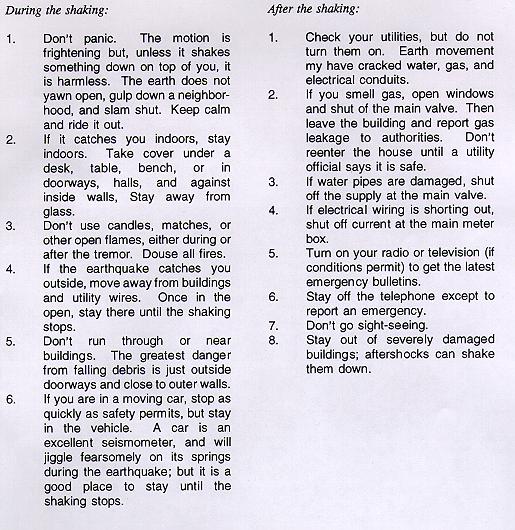
safety rules
A. Earthquake precursors
- are omens or events
which may be observed prior to an earthquake and can aid in predicting the
event
1. Dilatancy
·
is the swelling or bulging of the surface rock above an area
experiencing a buildup of stress in the rocks--the best example of this
phenomenon prior to an earthquake was in the Palmdale California area in the
1970's
·
tiltmeters and laser mirrors are used to measure the rate
and magnitude of the dilatancy--the use of tiltmeters and laser mirrors to
measure Earth surface bulging was treated previously in the discussion of
prediction of volcanoes
2. Changing habits of insects or
animals prior to an earthquake event
·
for some reason some creatures have an innate intuition
about an earthquake soon to happen and react to it accordingly--one of the best
examples is snakes awaking from hibernation prior to a large earthquake in
China
3. Strange glow emitted from rocks
prior to earthquake event
·
stresses in rock materials may cause a flow of electrons in
quartz (piezoelectricity)--some believe the electricity effect can ionize gases
causing a glow at the surface
4. Increase of radon gas
concentrations in the environment
·
prior to some earthquakes higher concentrations of radon gas
were detected in stream waters in the area--also prior to some earthquakes
higher concentrations of radon at the Earth's surface is believed to have
caused interferences in radio signals--stress in the rocks prior to an
earthquake could cause the release of more than normal concentrations of radon
gas into the environment
B. Earthquake control
- some have speculated
that lubricating rocks under stress would result in the release of smaller
bundles of energy (more but less energetic earthquakes) thereby avoiding
the "BIG ONE"-- some have suggested water or other fluids could
be added to the suspect area of stress buildup causing a lubrication
effect in the stressed area of the rocks
VIII. Earth's interior as deduced from
seismic waves
- structure and
composition of the interior of the earth has been determined from
information obtained from studies of body waves and meteorite composition
A. Body wave paths and velocities in the Earth's interior
1. Homogeneous vs non-homogeneous
interior Earth concepts
·
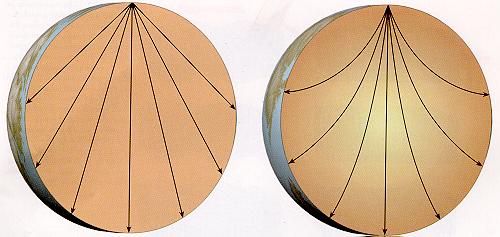
the paths of body waves moving through the Earth's interior
will be straight if the interior is homogeneous or broken or curved if not
homogeneous
·
click here to see the idealized
path of body waves –however,
see in the diagram a curved path if inhomogeneous
2. Specific
velocities and paths of body waves
·
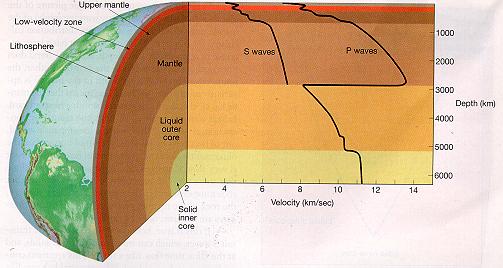
body waves are not straight therefore the Earth is not homogeneous--the
velocities of P and S waves increase with a function of depth changing
velocities at the boundary of each minor and major interior Earth section---at
the lower mantle and outer core boundary the P wave velocity decreases
significantly and the S wave ceases to exist which indicates the presence of a
liquid core
·
click here to see the specific
way body waves travel through the Earth
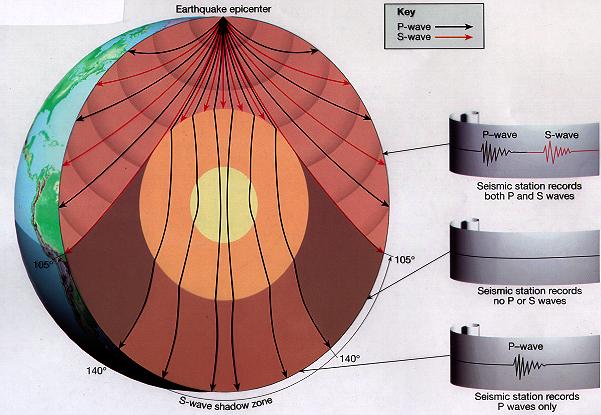
B. Shadow zones of P and S waves
- are areas on the Earth's
surface which do not receive P and/or S waves from earthquakes and can be
explained by the Earth's interior structure--note the P wave shadow zone
lies between 105-140 degrees from the epicenter on both sides of the Earth
while that for the S wave includes an area between 105 degrees on both
sides from the epicenter
- click
here to see which shows P and S shadow zones respectively
- from the results on
velocities, paths, and shadow zones or the manner in which the P and S
waves travel within the Earth's interior important information about the
Earth's structure can be obtained