Groundwater
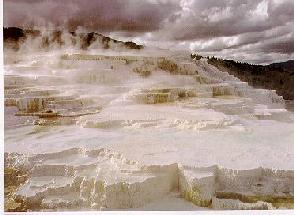
This photo is of
Mammoth Hot Springs in Yellowstone National Park-- the action of groundwater
can form caves, springs, and sink holes which can cause much damage to
buildings and other surface structures
I. Basic
information
A.
Definition and explanation of groundwater
- water below the Earth's surface occurring in open
spaces including fractures, joints, faults or other open spaces between
rock particles
- the amount of groundwater is strongly influenced by the
amount of infiltration which in turn can be affected by the other paths
taken by precipitation in the hydrologic cycle
- the following is a list showing the order of
availability of fresh water on Earth: ice sheets and glaciers,
groundwater, lakes and reservoirs, and river water
- click here to see fresh water
availability on Earth or see
bottom of page 240
B.
Kinds of groundwater
1. Connate
·
entrapped
brackish water found in the open spaces in the rocks
2. Juvenile
·
water
originating directly from a magma
3. Meteoric
·
fresh
circulating water in the open spaces in rocks and is the type we mostly refer to as "the
groundwater"
C.
Qualities of rock materials
- refers to the qualities of rock materials in respect to
the contained groundwater
1. Porosity
·
is
a measure of the water capacity of a rock material--a substance with a high
porosity can hold much water
2. Permeabilty
·
is
a measure of the ability of a rock material to transmit water and is
proportional to the degree of interconnection of voids between particles in the
rock--larger open spaces in a rock will favor a higher degree of interconnected
spaces--permeability in a rock substance allows water to circulate thereby
remaining pure through filtration--a rock with a high degree of permeability is
a rock which should yield quality groundwater
·
a
substance with high porosity does not necessarily possess good permeability
·
most
sandstones are good sources of quality groundwater because they usually have a
relatively high degree of porosity and permeability
·
rocks
such as pumice, scoria, shale, clay stone, and siltstone may have good porosity
but have poor permeability and would not be sources of quality groundwater
3. Specific yield
·
is
a measure of the amount of water obtained from a rock material
4. Specific retention
·
is
a measure of the amount of water retained by a rock (after extracting water
from it)
·
an
example of a non-rock substance which reflects specific yield and retention is
a sponge--after soaking in water a sponge can yield an amount of water by
squeezing it (specific yield) but will retain a certain amount (specific
retention)
5. Aquifer and aquiclude (aquitard)
·
an
aquifer is a permeable rock substance
·
an
aquiclude or aquitard is an
impermeable rock substance
II. Unconfined and confined groundwater
A.
Definitions
1. Unconfined
·
is
groundwater in an aquifer with a lower barrier for water movement but not an
upper barrier--which means there is an aquiclude or
impermeable substance located immediately below the aquifer---water can
fluctuate to a small or large degree up and down in the upper portion of the
aquifer
2. Confined
·
is
groundwater in an aquifer with a lower and upper barrier for water
movement--which means there is an aquifer located between a lower and upper aquiclude so water in the aquifer is limited or confined to
upper and lower movement
1. Zone of saturation
·
is
the area of open space in the rocks filled with water--the area in the rocks
with the highest groundwater concentration
2. Water table
·
is
the upper level of the zone of saturation--unconfined groundwater has a water
table which can fluctuate up and down over relatively large distances
3. Zone of aeration (Vadose zone)
·
the
area above the water table not saturated with water and filled primarily with
air--water is present in this area because of specific retention and by
capillary action (rising of water from the water table in tiny thread-like
openings between particles)--capillary action is greatest in the capillary fringe
area
click here to
see groundwater zones – or see
pages 243-244
4. Changing levels of water table
·
the
lowering (discharge) of the water table may take place if the following usage
is greater than the replenishment of water to the zone of saturation: 1.
continued pumping of groundwater; 2. plant usage; 3. leaking of water onto the
surface into streams and lakes
·
the
rising (recharge) of the water table may take place if the rate of groundwater
replenishment (primarily by infiltration) is greater than the rate of depletion
5. Groundwater interrelationship with streams
·
in
some cases streams can directly supply groundwater and vice versa—see
pages 244 and 246 in text
o
a.
an effluent or gaining stream is supplied by groundwater and is abundant in
humid climates ---a type of spring
o
b.
an influent or losing stream supplies water to the groundwater and is
characteristic in arid climates
o
click here to see effluent and influent streams
o
c.
a spring is a natural emission of
groundwater at the ground surface and can form some surface streams --this is
the nature of many streams in the Ozarks--a hot spring is about 10-15 degrees F
warmer than the mean annual air temperature in the locality it occurs and is
warmer because of an association of the groundwater with a hot igneous
intrusion prior to emission click here to see Mammoth Hot
Springs in Yellowstone National Park –see
page 247 in text
§
a
spring can be related to a perched water table--this arises when there is
groundwater located in the zone of aeration above the main or regional water
table
§
click here to see a perched water table—or see
page 243 in text
§
a
geyser is a hot spring which is ejected at the surface with great force and
sometimes at consistent intervals---Old Faithful in Yellowstone National Park
is the best example of a geyser
§
click here to see Old Faithful geyser or see
page 253 in text
§
click here to see hot springs distribution in the US
6. Pumping of groundwater
·
heavy
pumping of groundwater can cause a cone of depression in the water table from
groundwater drawdown and may leave many shallow wells dry
·
click here to see pumping effects on groundwater or see
page 248 in text
C.
Confined groundwater
- artesian water is a
special type of spring associated with confined groundwater--flowage of
subsurface water in a confined aquifer causes a pressure surface level
which defines the level or elevation to which water can rise naturally--if
a surface opening is connected to the aquifer and is below the pressure
surface water can flow naturally at the surface, otherwise it must be
pumped
- click here to see artesian water
or see page 249 in text
III. Groundwater effects in carbonate rocks
A.
Subsurface solution and precipitation effects
1. Chemical mechanism
·
when the underlying rock is carbonate in composition acid
groundwater dissolves the rock to form openings (caves, caverns, etc.)--when
the groundwater rich in calcium bicarbonate attains a less acid condition, precipitation
of CaCO3 will occur forming cave precipitates
2. Caves and cave precipitate forms
·
some
examples of famous caves are: Mammoth Cave, Kentucky; Shenandoah Caverns,
Virginia; Carlsbad Caverns, New Mexico; Onondaga and Merrimac Caverns, Missouri
– most caves form below the Water Table –see
pages 253 to see cave formation
·
Missouri
has more mapped caves than any other state and has been called "the Cave
State"
·
the
cave precipitate forms are: 1. stalactites which grow from the cave roof; 2. stalagmites
which grow upwards from the cave floor; 3. columns which form when stalactites
and stalagmites grow together--stalagmites, stalactites and columns are known
as speleothems
·
click here to see speleothems
– see page 256 to see speleothems
B. Surface features
- Karst
topography is a pitted surface condition resulting from subsurface
solution action and includes sinkholes (individual collapsed structures),
and solution valleys formed from the merging of individual
sinkholes--enormous sinkholes are still another example of mass wasting
- click here to see Karst features
or page 257 in text
- click here to see a large sink hole and
mass wasting in Florida – see bottom of page 257 for another picture of same
sinkhole
IV. Groundwater and stream pollution problems
- as mentioned earlier there is a strong
interrelationship between surface streams and groundwater and if one is
polluted or tainted the effects can be transferred to the other
A.
Saltwater encroachment and pollution of groundwater
- pumping effects or
mixing of groundwater and saltwater can cause undesirable results
- click here to see salt water
encroachment on fresh water
B.
Septic tank leaks
- click here to see septic tank
pollution – see
page 251 in text
- click here to see more of septic
tank pollution
- Sequiota Springs in Springfield
is an example of septic tank pollution
C.
Landfills and Industry
1. Landfills
·
landfills
have evolved from "dumps" to a "state of the art" way to
accumulate and contain our wastes--layers of clay and plastic liners at the
bottom of the fill have recently been used to help contain leach ate--landfills
have been constructed on top of impermeable layers of rock as shale to help
contain leach ate
2. Industry
·
industry
has often been guilty of dumping pollutants into streams and groundwater and
also adding by-product gases to the atmosphere resulting in acid rain--waste
water treatment facilities have also emitted elevated levels of phosphates
causing high algae concentrations to form
D.
Storm water runoff
- urbanization can cause a decrease of natural
infiltration of precipitation resulting in more runoff--if runoff is not
controlled flooding can occur as well as the spreading of pollution
click
here to read more on topics covered above